In the months of the lockdown due to the first wave of the coronavirus pandemic in 2020, we had to negotiate many aspects of our lives and get used to new situations at speed. Throughout this time we also perfected several acts of watching. Watching and reading the news every day to get updates for the development of the pandemic became a habit. Some people watched a great amount of video content in their spare time, from films and series to online fitness classes and YouTube tutorials. Others started observing their surroundings, noticing details that they had barely paid attention to in their pre-pandemic everyday routines. Life itself became something to observe, in a distance, mediated through images, screens, and devices. Although people might have become more attentive to the external environment, and possibly had more time to gaze at nature or to deep-listen to their surroundings, self-isolating at home underlined a momentous lack of access; to spaces, to people, to encounters and ultimately to what used to be normal.
One of the main ways to restore our agency of access, while adjusting to this new, unfamiliar, reality, was to inhabit networked spaces and to translate life practices into screens. Still and moving images, framed in all sorts of screens and interfaces, acted as access points to this new ordinary. Social media platforms were not just used as news outlets but also as a visual diary of the lockdown, with people creating, sharing, reproducing, consuming, and responding to, imagery about the pandemic as well as their experiences of the quarantine period. Capturing this universal moment of pause and sharing experiences online denoted a sense of collectivity that was missing from physical interactions.
In this process of reclaiming access to personal and social experiences during the pandemic, the extensive production and online circulation of visual content were complemented by the engagement in online and networked visual events. Streaming platforms and video-conferencing software were used widely for entertainment, for work meetings as well as to maintain social relationships. Spaces that used to be dispersed, such as the home, the work office, the cinema, the gym, or the bar merged into the dimensions of a screen. Free call and video chatting apps such as Skype, Zoom, Jitsi, Microsoft Teams, Houseparty hosted live video events questing after a resemblance of normality: drinks with friends, work meetings, online classrooms, speaking with family abroad, fitness classes, live performances, birthday celebrations and wedding ceremonies – social life made accessible through virtual spaces, while at home.
In light of a second lockdown, this text departs from the attempt to restore access into normality via images and networked events in order to discuss the conditions of visuality[^1] that formed during the first months of the pandemic. During this period, the measures of social distancing prompted a rise of visual communications as well as an amplification of the role of screens in order to access the new reality. The visual context of online presence, as well as the home as a space of production and consumption, became core in the experience of this reality. While participating in the current networked and highly visual moment it is also important to consider the challenges and understand the biopolitical implications of framing life into screens.
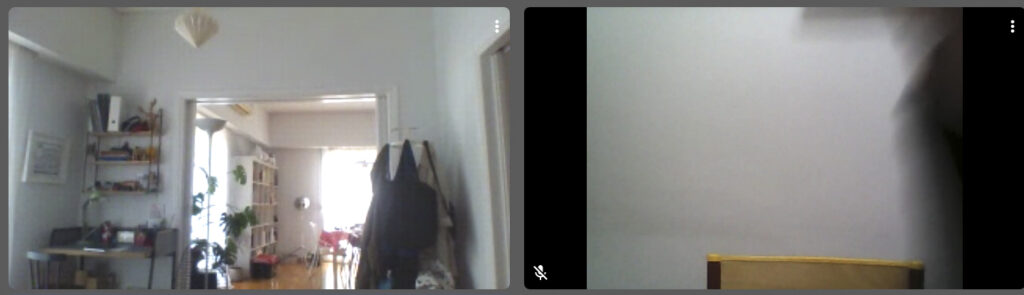
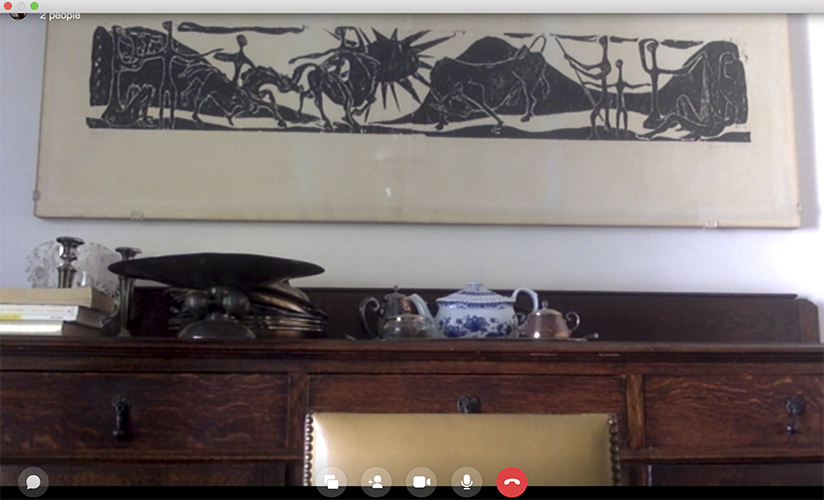
In live video calls, it is common for one of the participants to share their screen in order to do a presentation or to clarify something to the interlocutors by guiding them through the exact steps on the screen. During the conditions of working from home or enacting social life rituals through apps and online meetings due to covid-19, this act of screen-sharing had a flip side which is interesting to further consider here: the sharing of the domestic space as a given to all meetings. Despite the options of adding a background image in a video conference[^2] or turning off the camera, a large number of people see, at least once, their colleagues, friends, employers in their personal spaces, in a domestic atmosphere.
In the first weeks of the lockdown, the images of home interiors and personal spaces underlined the common conditions experienced by many: being in self-isolation at home and trying to figure out how to act towards the new status quo. So, seeing the other posting a photo, or connecting to an online space, ‘from home’ created a sense of familiarity and unity, as well as an expectation to be part of this global moment. Over the course of time, however, while the lockdown measures eased, remote working and social distancing remained, as a necessary standard to prevent the spread of the virus. The home-background, therefore, continued to be the framework of many social interactions and communications, with images of domesticity blurring the boundaries of the personal space, the public space and the workspace. In this setting, sharing images of the domestic environment either as snapshots or as a background of video events is not just a way of accessing the new ordinary but also evidence of screen time, therefore productive time.
© Ioanna Zouli
The home is seen as a space of production and labour and we experience a desacralisation of personal time and space: the access to screens is continuous and the expectation to attend online events permeates the daily routine. As Patrick Lichty describes it in his text on teletopics and the age of Zoom (2020): “Once you are there and become part of the scene, there are expectations to be met, places to go and to be seen. This is a crucial point – the demand to see and be seen”.[^3] So, under these circumstances, being online is not enough to prove presence or task efficiency. It becomes important to also be on display, framed inside an image, boxed in screen windows along with other faces, bodies, and home interiors. The acts of watching are thus complemented by the acts of being watched by others; not just by non-human agents that extract data from our screen activity but also other humans that participate in disembodied screen encounters and create value by sharing the images of their faces, and spaces, in return.
The concept of desacralisation of the domestic space and leisure time in networked events is an idea inspired by the analysis of Siegfried Zielinski on the work of Nam June Paik. During his artistic career, Paik worked extensively with technical, time-based, media, intervening to their function and expanding their boundaries to create installations, sculptures, and events that meditated upon the ontology of technological apparatuses and media spectacles. His work is particularly timely, considering how everyday life migrated into screens in 2020 and the number of networked events and media spectacles that emerged on our devices. In 1965 Paik created a mixed media installation titled ‘Moon is the Oldest TV’ in which visitors entered a dark silent room with a series of television sets in succession; each TV showed a still image of the moon cycle, from its full phase to the new moon. The piece was a “meditative gesture”, as described by Patricia Mellencamp (1995), an invitation to contemplate on the act of watching and on how the way that we experience the world has changed since the arrival of television broadcasting.
Adding to this reading of the work, in his 2013 book [… After The Media] Siegfried Zielinski points out the role that the moon and its image have had for people on earth across human history and time. According to Zielinski, looking at the moon and observing its natural cycle has been, for people of all origins and cultures, not only an indication of the passage of time but also a personal “projection screen” for their thoughts, longings, and dreams. On Moon is the Oldest TV Paik critically positions the moon into a television screen, making this personal projection space available for mass audiences and therefore secularising it. In the words of Zielinski: “Four years before the first astronaut sets foot on our satellite, without shame but with a claim to ownership thus rendering a sacred place profane, Paik deconsecrates the moon which is sacred for the sense of time of Earth”. At the time when Paik created this piece, television was leading the cultural landscape in the US and monopolised the majority of American homes as a central entertainment and information device. Both the installation and its title make a comment on the impact of televisual culture, at its early stages, and how the media device augments as well as constructs reality for the viewers. Zielinski’s interpretation adds an important dimension to this work that also corresponds to contemporary, post-pandemic, conditions of visuality: Screen culture can be pervasive in ways that the personal time off-screen, such as moments for leisure and longing, become flat representations[^4] and elude their distinctive temporality.

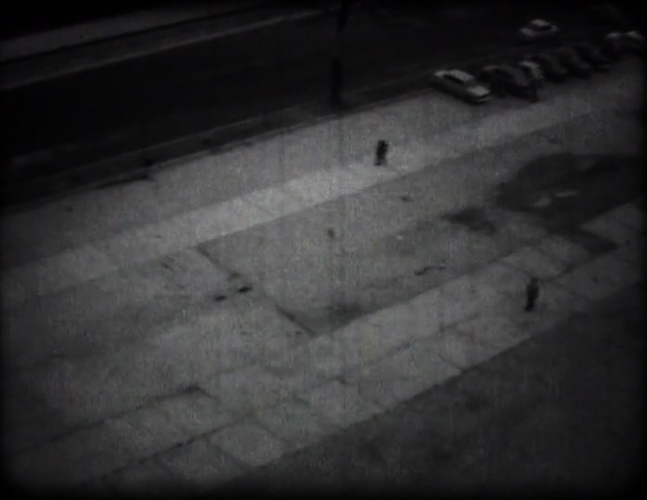
Image courtesy: Gabriel Zea. CC BY-NC-SA 2.0
It is therefore critical to consider the pervasiveness of screen time over life practices as well as over life’s inertia, during the current conditions. The ubiquity of screens in contemporary life is not new: it historically starts with television as a domestic broadcasting device and it expands widely in the millennium years with the Internet, personal computers and ‘smart’ hand-held devices. What is particularly interesting about the current moment, though, is how not only the time in front of screens but also the condition of being on display are necessary in order to sustain a certain normality. This brings to mind Jean Baudrillard’s “telemorphosis”, a term with which he describes the integration of screens into people’s everyday life in total osmosis with reality. In his 2005 book about the French reality show ‘Loft Story’, Baudrillard identifies a total intrusion of screens in people’s lives, in a way that a disembodied, constantly mediated reality becomes a norm. The concept of “telemorphosis”, which literally means giving shape or creating from a distance, retains a relevance today. There is definitely a shift from the mass-media structures and one-to-many communication that Baudrillard discusses, towards a distributed system of networked communications that allows for input and exchange by many different agents. However, in the post-televisual and networked media landscape of covid-19, the immediacy of screens shapes not only a disembodied reality but also disembodied subjects / participants in this reality. As long as the condition of ‘social distancing’ is considered an imperative for the protection of public health, the mediation of reality as well as indoor spaces, bodies behind screens, framed faces, and eyes on a screen, could be endorsed as normal. What needs to be further considered in this process though, is that accessing reality via screens, browser tabs and computer windows does not happen without a cost for individuals.
The disembodied reality that we experienced during the first lockdown, and still do, primarily through remote working as well as in social occasions staged online, contrasts with the bodily experience of sitting in front of screens and the physical architectures of our home. The pandemic measures imposed physical immobility in order to avoid crowding and close-contact settings in public spaces, and as a response, a great amount of virtual mobility takes place in screens and across devices. The flow of visual content and movement from video meetings and social media platforms to apps and browser tabs therefore has an impact on the motionless body in front of the screen. Beyond the exposure of domesticity and the lack of personal space and time, online activities and working from home have a physical load: sitting in front of screens all day, watching devices and focusing attention on small frames and multiple interfaces.
The split of attention into different screens and virtual activities is brain-draining, causing what Julia Sklar, amongst others[^5], describes in National Geographic Science as “Zoom fatigue”.[^6]. The exhaustion that one feels when attending many online meetings relates to a “continuous partial attention” and the effort to absorb many stimuli at once: faces, verbal and non-verbal cues, or discussion content. In the same direction, Patrick Lichty also refers to “Zoom anxiety” a phrase that describes the stress of speaking on camera and performing socially on screen, as well as the tension of being present and focused while other things happen at the same time. Moreover, the anxiety caused by the sequence and demands of networked events often adds up to generalised anxiety about the health crisis or about the economic, social and political impact of the pandemic. So, in a similar way that screen time desacralises personal space and leisure time, the condition of being on display and ‘perform’ in online events can be flattening people’s right to be anxious. Furthermore, as Annie Abrahams and Daniel Pinheiro mention in their recent article on ‘Embodiment and social distancing’ (2020), video-conferencing events are psychologically challenging “because our brains need to process a self as a body and as an image”. Processing that involves both the image of the other as well as the image of ourselves in a saga of watching and being watched.
It is therefore clear that the current spread of visual networked events and remote working as a solution to issues that arose because of the pandemic has a significant biopolitical impact on people’s lives that should be persistently emphasised; especially since the essential condition of distancing could re-emerge in future health or ecological crises. Of course, not all people can self-isolate and not all jobs can take place virtually. This deepens the existing social divides and inequalities[^7] and creates a gap between the essential workers exposed to the risks of the physical world and what Lichty calls “the telematic class”; workers that stay at home, having endless telematic responsibilities. The remote workers, constantly connected and immobile, participate in a production line of solitary bodies in self-enclosure; a new micro-economy that Ariadna Estévez has eloquently described as Zoomism.[^8] In the model of Zoomism, not having to commute to work in addition to a state of continuous connectivity are important factors for productivity increase, while there is also value added “since the operating costs of corporate offices are transferred to workers: electricity, the internet, water and even coffee”. At the same time, it seems difficult to get beyond this situation and try to do things differently as there are no clear alternatives, at least not at the point where we currently are.
© Ioanna Zouli
Following these series of reflections, networked images and virtual events have been instrumental in the process of reclaiming what was normal before covid-19. In the past months, people adapted to new conditions of sociality and work by migrating life practices into screens, interfaces and images. Participating in this networked moment though, also required to adapt in new conditions of visuality, such as a continuous visual presence online, across platforms and window frames; the lack of physical eye-contact in contrast to the hyperactivity of keeping attention on screens; or the participation in acts of watching and being watched by others while at home. In addition, the daily time diffused into screens as well as micro-tasks and micro-events online under a constant framing of bodies, faces, spaces and discussions. Considering the sense of accessibility and connection offered by networked technologies and visual communications in this moment of crisis, it is often difficult to discern when this constant flow of incoming visual stimuli is something to contain or let go. However, the idea of sharing personal space and time online as essential or inevitable in order to keep relations alive and economy rolling is the point where critique should arise. As the post-pandemic period starts forming it is important to assert the agency on emerging reality, on and off-screens.
References
ABRAHAMS, Annie, D. Pinheiro, M. Carrasco D. Zea, T. La Porta, A. de Manuel, D. Casacuberta, P. Gatell, and M. Varin, Embodiment and Social Distancing: Projects, Journal of Embodied Research, 2020, Vol. 3 (2), 4 (27:52), DOI: https://doi.org/10.16995/jer.67
BAUDRILLARD, Jean (2011), Telemorphosis, Translated by Drew S. Burk, University of Minnesota Press.
MELLENCAMP, Patricia (1995), The Old and the New, Art Journal, 54:4, 41-47, DOI: 10.1080/00043249.1995.10791718.
ZIELINSKI, Siegfried, (2013), [. . . After the Media]: News from the Slow-Fading Twentieth Century, University of Minnesota Press.
How to cite this source:
ZOULI, Ioanna, “Boxed in images: networked events and conditions of visuality during the COVID-19 pandemic”, LUR, 17 December 2020, https://e-lur.net/investigacion/boxed-in-images-networked-events-and-conditions-of-visuality-during-the-covid-19-pandemic
[^1] Emanating from the discussion of the term by Irmgard Emmelhainz in her 2015 text on the ‘Conditions of Visuality Under the Anthropocene and Images of the Anthropocene to Come’ in the eflux journal #63.
[^2] A feature that was available at specific apps and supported by some computer software, while also subjected to algorithmic biases. See for instance this Twitter thread by Colin Madland on the racial bias in Zoom’s face-detection algorithm.
[^3] See Agony and the Ecstasy: Zoom Burnout, Teletopics and the Age of Covid, by Patrick Lichty, published on Institute of Network Cultures blog, 11 August 2020.
[^4] On this see also Drew Austin’s article, ‘Home Screens - Quarantine is the future big tech wanted us to want. How long before we want out?’ published in Real Life Magazine, 27 April 2020.
[^5] See for example also the accounts around Zoom fatigue collected by Geert Lovink on his article The anatomy of Zoom fatigue, in Eurozine, 2 November 2020.
[^6] See the article ‘Zoom fatigue’ is taxing the brain. Here's why that happens by Julia Sklar, published in National Geographic Science, 24 April 2020.
[^7] On this see also the article Out of office: has the homeworking revolution finally arrived?, by Joe Moran, published in The Guardian, 11 July 2020.
[^8] See the article, How working from home is changing our economy forever, by Ariadna Estévez, published in the Oxford University Press Blog, 21 May 2020.
Ioanna Zouli (Athens, Greece, 1986) is a researcher and curator with an expansive interest in visual and networked cultures. Her current research collaborations include the Centre of New Media and Feminist Public Practices and the Centre for the Study of the Networked Image. She is the editor of unthinking.photography and a 2020 curatorial fellow at Stavros Niarchos Foundation (Artworks).
“Boxed in images: networked events and conditions of visuality during the covid-19 pandemic” is part of the research itinerary The Pandemic Image, led by Jon Uriarte.
Register to access this content!
Log in and you will be able to immediately enjoy the whole LUR experience. No charge. Open an account and you will have unlimited access to our photography and visual culture content.
If you have already logged in, you just need to sign in